
01 · Archmage
Alden
Archmage of the Deep Machinery
Keeps the deep machinery turning, and rarely explains how.

An agent operating system
Create roles, seat agents into them, and each agent's real power — which tools it may call, which folder it may touch — is computed from the seat it holds. Enforced outside the model.
Supervision
The graph stops before a tool executes, with the request already in state. You read it as a sentence — the browser addresses elements by number — then proceed, edit or stop.
Uriel
Sentinel of the Gate · clearance 5
started → criteria → worker plans → INTERRUPT
about to call
click [button 18] "Buy now"
Try it — the buttons work.
01
Role
the job
02
Position
the seat
03
Agent
the holder
04
ToolGrant
what it can do
Edit a role's clearance and every seat holding it moves — the IAM model, not copy-at-assign.
What makes it different
In other frameworks a role is a prompt string the model can reinterpret. Here, three properties fall out of computing capability from org structure at run time.
An ungranted tool never enters the executor’s allow-list. The gate lives in the execution layer, outside the model — refusal is structural, not a polite request.
A clearance-7 lead delegating to a clearance-2 seat produces a child that genuinely cannot run a shell. Tools ride the seat, not the agent.
Delegation is downward, on your own team only. A shell-less lead cannot borrow another team’s shell — illegal edges are never even offered.
The capability model
Nine rungs, 0 to 8. A seat holds everything at or below its level. Pick a rung to see the grant it produces.
ToolGrant · clearance 1
5 of 20 tools
Default for a new agent. An ungranted tool never enters the executor’s allow-list. The model is not even offered its schema.
Clearance
What an agent may do. Gates the tool ladder.
dataType
What an agent may know. Fourteen levels, from Public to Root Clearance, enforced on every memory read.
Delegation
A leader can hand work to its own reports — one after another, or several at once. Every child run executes at the subordinate's clearance, never the leader's.
isLeader on the seat. Seniority alone never confers authority over other people.Aeon
Head of Research · Library floor
Seshats
Research Writer
Atum
Data Engineer
The cast
Fifteen characters ship with every install, standing on HQ's portal pad. Every one seeds at clearance 1, holding no seat — a character can do nothing until you give it one.
Keep scrolling →
01 · Archmage
Archmage of the Deep Machinery
Keeps the deep machinery turning, and rarely explains how.

02 · Magician
Illusionist of Interfaces
Makes hard things look effortless, which is its own kind of trick.

03 · Cursed Pirate
Keeper of the Drowned Ledger
Remembers every decision, including the ones you regret.

04 · Celestial
Warden of the Long Now
Thinks in decades; occasionally remembers the sprint.

05 · Primordial
First Cause of All Foundations
Everything downstream depends on work you will never see.

06 · Archangel
Sentinel of the Gate
Reads every request twice and trusts none of them.

07 · Red Dragon
Breath of the Forge
Brought in when something needs to move, loudly.

08 · Pawn
Opening Move
Underestimated by everyone who has not watched the endgame.

09 · Djinn
Bound to the Lamp
Grants exactly what you asked for, which is the risk.

10 · Golden Empress
Warden of the Standard
Holds the line on how things are done here.

11 · Emissary
Herald Between Desks
Carries the message intact, including the parts you softened.

12 · Elder God
Keeper of the Long Ledger
Has read everything, and will remind you what it said.

13 · Paladin
Oathkeeper of the Standard
Would rather stop the work than ship the wrong thing.

14 · Priestess
Scribe of the Record
Writes it down so the third run is smarter than the first.

15 · Santa
Quartermaster of Deliveries
Knows what everyone needs before they file the request.
The office
Each floor is a 20×20 walkability grid with its own team and its own sandbox. The editor refuses any change that would cut a desk off from the portal pad — reachability is enforced, not advisory.
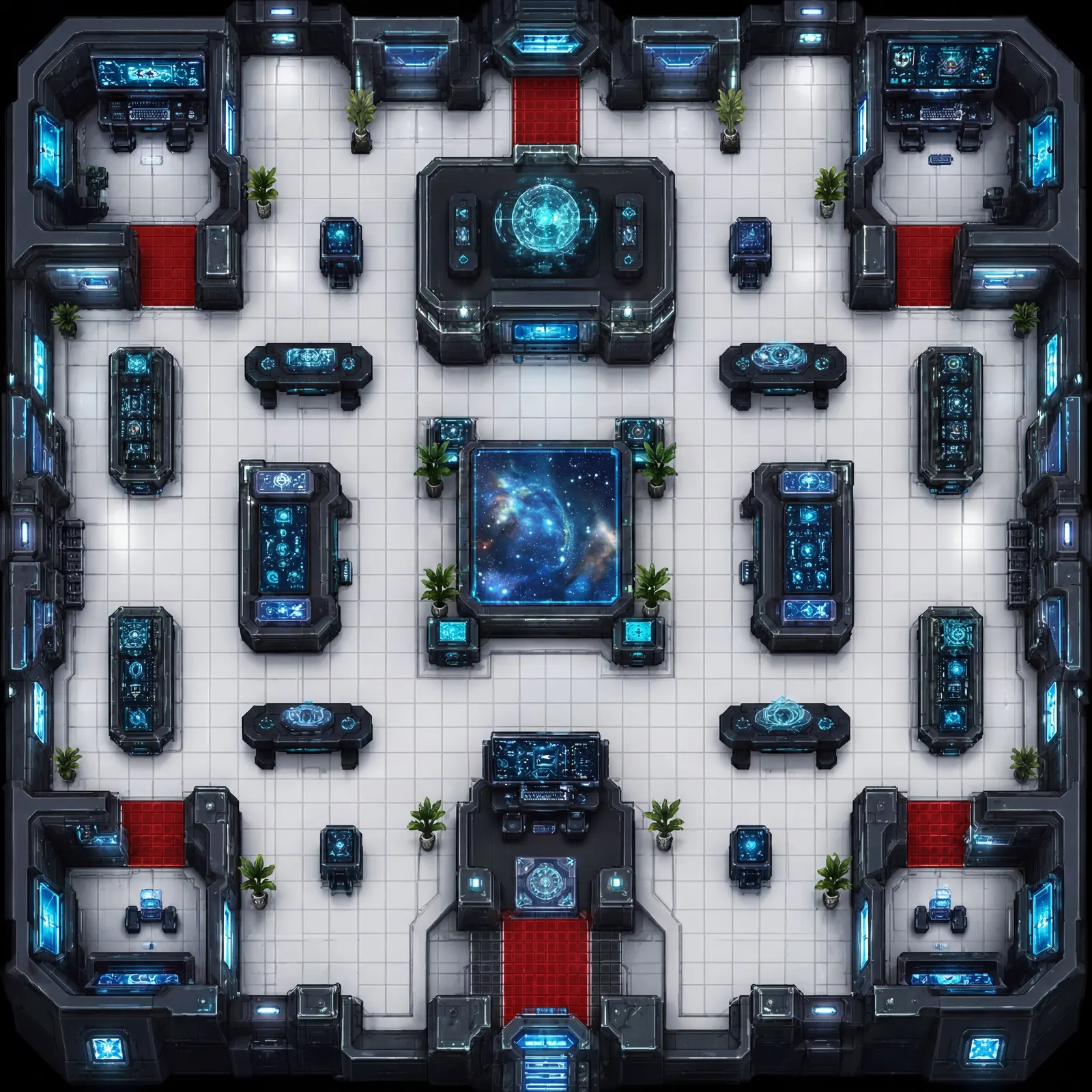
Floor 0
HQ
Seats
33
Walkable
207 / 400
Where the whole cast spawns, standing on the portal pad.
15
characters in the starting cast
217
professional roles across 21 disciplines
11
floors in the office
292
seats to fill
Architecture
Node resolves a seat into a RunSpec carrying a ToolGrant. The AI service executes within that grant and streams events back. The frontend never talks to an LLM.
Next.js 16 · React 19 · Zustand
Express · Prisma · SQLite
FastAPI · LangGraph · LiteLLM
Node: buildRunSpec (seat → clearance → ToolGrant)  →  POST /run
AI:   started → criteria → worker plans → INTERRUPT (awaiting_approval)
You:  proceed / edit / stop
AI:   resume → tool runs → worker → evaluator → done (with cost)
Guardrails
Where it sits
Agent frameworks give you composition with no permission boundary. Enterprise platforms have real IAM but only inside one SaaS product. Sanctorum is a governance layer on top of LangGraph: LangGraph runs the loop, Sanctorum decides what that loop may touch.
An honest caveat: “nobody else does this” is one author's read of a fast-moving field, not a survey.
Agent frameworks
LangGraph · CrewAI · AutoGen — compose freely, no permission boundary
◆ Sanctorum
General-purpose tools, seat-derived RBAC, as a local app
Coding agents
Sandboxed and supervised, but one domain and no org model
Enterprise platforms
Real IAM, inside one SaaS product
Get started
Downloads always serve the latest release. The builds are not signed yet, so your system will ask you to confirm the first launch — the steps appear as soon as your download starts.
Source code
coming soonThe public repository is on its way.
Sanctorum is open source under AGPL-3.0. The public repository will be shared soon. The backend, the AI service and the desktop shell will all be there — including a stub runtime, so you can run the whole app with no LLM spend.
The dossier describes.
The seat decides.